Última actualización: Agosto 16, 2026
Medicina regenerativa y longevidad saludable: Lo que la ciencia sabe hoy sobre las células madre mesenquimales
Durante las últimas dos décadas, Las tecnologías celulares han evolucionado desde un concepto experimental hasta convertirse en uno de los campos de más rápido crecimiento de la ciencia biomédica traslacional..
Hoy, La medicina regenerativa ya no se centra exclusivamente en el tratamiento de enfermedades en fase avanzada..
Cada vez hay más investigaciones dedicadas a comprender cómo funciona el envejecimiento biológico., estrés fisiológico crónico, La desregulación inmune y la disminución del potencial regenerativo pueden estudiarse y abordarse antes de que se desarrollen cambios patológicos irreversibles..
El envejecimiento comienza mucho antes de lo que la mayoría de la gente supone
Contrariamente a la creencia común, El envejecimiento biológico no comienza repentinamente en la vejez..
La biología molecular moderna muestra que los cambios relacionados con la edad se pueden medir ya en la tercera y cuarta décadas de la vida..
Estos incluyen:
• disfunción endotelial progresiva;
• aumento del estrés oxidativo;
• inflamación crónica de bajo grado;
• reducción de la eficiencia mitocondrial;
• remodelación gradual del sistema inmunológico;
• disminución del potencial regenerativo;
• recuperación más lenta después de un estrés físico o psicológico prolongado.
La mayoría de las personas permanecen clínicamente sanas durante este período.. Sin embargo, Los cambios moleculares continúan acumulándose silenciosamente durante muchos años antes de que aparezca la enfermedad clínicamente evidente..
Desde la perspectiva de la medicina regenerativa, Este período representa una oportunidad importante para apoyar la resiliencia fisiológica del cuerpo mientras sus propios mecanismos de reparación permanecen activos..
Células madre mesenquimales: coordinadores biológicos de la regeneración
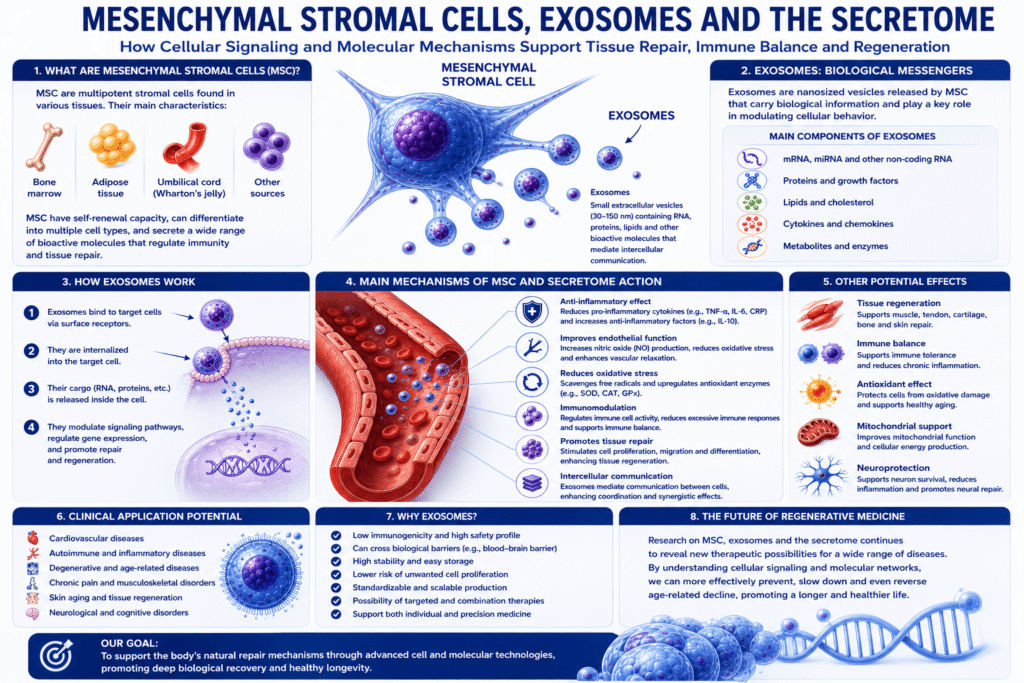
Células madre mesenquimales (MSC) Se encuentran entre las poblaciones celulares más estudiadas en medicina regenerativa..
La evidencia científica actual indica que su función principal no es la reposición directa de tejidos dañados.
De lo contrario, Las MSC funcionan como centros biológicos de señalización celular..
Después de la administración intravenosa, Liberan un secretoma complejo compuesto por cientos de moléculas biológicamente activas., incluido:
• factores de crecimiento;
• citoquinas;
• vesículas extracelulares;
• exosomas;
• proteínas inmunomoduladoras.
Juntos, Estas moléculas de señalización influyen en numerosos procesos fisiológicos implicados en la reparación y adaptación de los tejidos..
Los mecanismos de señalización mediados por MSC pueden contribuir a:
• regulación fisiológica de la inflamación;
• mantenimiento de la función endotelial;
• homeostasis vascular;
• mejora de la microcirculación;
• procesos de reparación de tejidos;
• mantenimiento de la función mitocondrial;
• regulación inmune;
• interacción entre las poblaciones de células madre del propio cuerpo.
Son precisamente estas propiedades biológicas las que explican por qué MSC continúa atrayendo un interés considerable en diferentes áreas de la medicina regenerativa..
Recuperación biológica después del estrés crónico
El estrés psicológico crónico se considera cada vez más un factor biológico sistémico, no es simplemente un estado emocional.
La activación prolongada de los mecanismos de estrés puede influir:
• equilibrio inmunológico;
• señalización inflamatoria;
• calidad del sueño;
• regulación metabólica;
• función vascular;
• metabolismo energético celular;
• resiliencia fisiológica general del cuerpo.
Un concepto científico de recuperación biológica
Células madre SBN ha sido desarrollado como un programa de medicina regenerativa diseñado para apoyar la recuperación biológica a través de tecnologías celulares avanzadas..
En lugar de centrarse en un solo sistema de órganos, Este concepto reconoce que el envejecimiento biológico y el estrés fisiológico crónico implican múltiples redes biológicas interconectadas..
El objetivo científico del programa es respaldar los mecanismos de reparación intrínsecos del cuerpo a través de tecnologías celulares regenerativas cuidadosamente seleccionadas administradas en entornos clínicos acreditados..
Dos estrategias regenerativas
Opción 1
Células regenerativas alogénicas de un banco de células certificado
El primer enfoque utiliza células regenerativas derivadas de donantes que se someten a preparación y control de calidad riguroso dentro de instalaciones de bancos de células especializadas..
Porque el producto celular se prepara con antelación., El procedimiento clínico generalmente se puede completar durante una sola visita..
Opción 2
Células madre mesenquimales autólogas personalizadas
El segundo enfoque se basa en un protocolo personalizado..
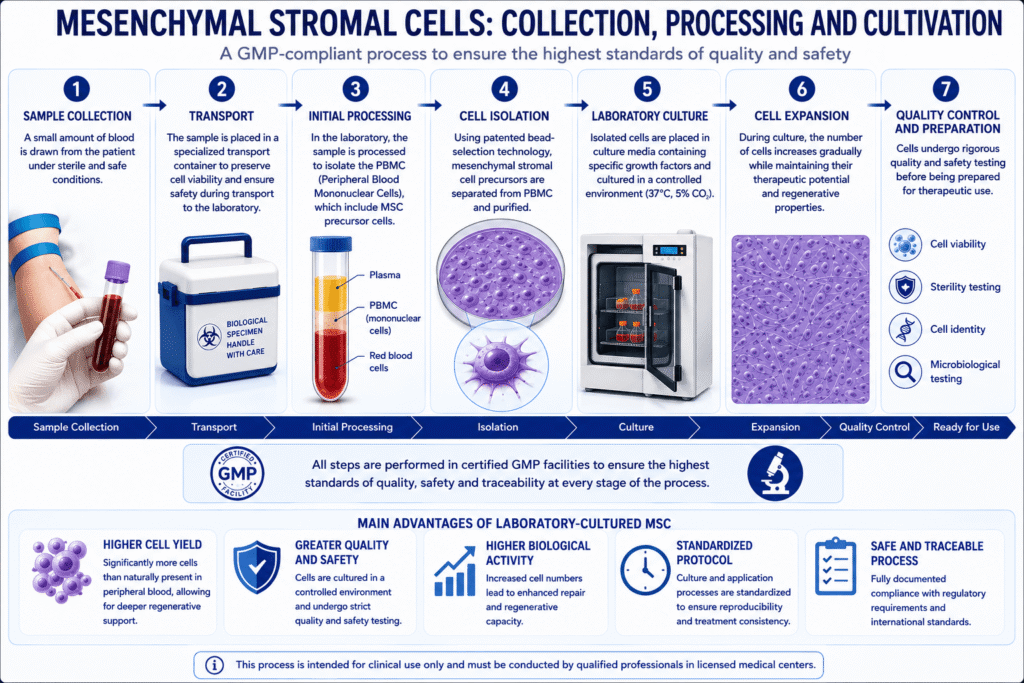
Durante la primera visita, Se recolecta una pequeña muestra de sangre para el procesamiento de laboratorio y la expansión de la población de células regenerativas del propio paciente bajo Cumple con GMP condiciones.
Después del cultivo en laboratorio., las células autólogas expandidas se administran por vía intravenosa durante una segunda visita aproximadamente una semana después.
Este enfoque tiene como objetivo proporcionar una concentración sustancialmente mayor de células regenerativas que la que está naturalmente presente en la circulación periférica mientras se utiliza exclusivamente el material celular del propio paciente..
Por qué Barcelona?
El Células madre SBN El programa clínico se imparte a través de nuestra infraestructura clínica en Barcelona..
La ciudad combina instalaciones médicas reconocidas internacionalmente., Certificado GMP capacidades de laboratorio, y equipos clínicos multidisciplinares con amplia experiencia en medicina regenerativa.
Todos los procedimientos clínicos se realizan de acuerdo con el marco legal y regulatorio aplicable del país en el que se brinda el tratamiento..
Perspectiva científica
La medicina regenerativa está transformando nuestra comprensión de la salud humana.
Históricamente, La medicina se ha centrado principalmente en el diagnóstico y tratamiento de enfermedades..
Las tecnologías regenerativas basadas en células introducen un paradigma complementario: Apoyar los mecanismos de reparación endógenos del cuerpo antes de que el deterioro funcional alcance importancia clínica..
El creciente cuerpo de evidencia experimental y clínica destaca la importancia de la modulación de la inflamación., mejora de la reparación de tejidos, apoyo a la biología vascular, y optimización de la regulación inmune.
El Células madre SBN El programa se ha desarrollado dentro de este marco científico..
Referencias científicas seleccionadas
Pittenger MF et al.. Perspectiva de las células madre mesenquimales: Biología celular al progreso clínico. Medicina Regenerativa NPJ. 2019.
Caplan AI. Células madre mesenquimales: Es hora de cambiar el nombre! Medicina traslacional de células madre. 2017.
Lunyak VV, Amaro Ortiz A, Gaur M. Secretoma de células madre mesenquimales en la reparación y regeneración de tejidos. Fronteras en biología celular y del desarrollo. 2022.
Golpaniano S et al.. Infusiones alogénicas de células madre mesenquimales humanas para la fragilidad del envejecimiento (Ensayo CRATUS). Revista de gerontología: Serie A.
Tompkins BA y otros. Terapia con células madre mesenquimales para la fragilidad del envejecimiento. Revista de gerontología: Serie A.
Estas publicaciones reflejan la literatura científica en rápida expansión sobre la biología de las células madre mesenquimales., inmunomodulación, señalización regenerativa, y sus posibles aplicaciones en el deterioro fisiológico relacionado con la edad.

Revisión de casos científicos
¿Le gustaría saber si los programas clínicos actuales, desarrollos recientes de investigación, o enfoques emergentes pueden ser relevante para su situación individual?
Envía tu pregunta a nuestro equipo científico. La oficina central de NBScience en el Reino Unido coordina consultas a través de la red internacional de centros médicos, científicos, y consultores especializados.
- Revisión de la información que proporcionas.
- Información relevante sobre programas clínicos y de investigación.
- Una respuesta clara y centrada en tu situación.
Sin compromiso. Su pregunta será revisada de forma confidencial..
Información educativa y de investigación únicamente.. Este servicio no constituye consejo médico, diagnóstico, prescripción, o un personalizado recomendación de tratamiento.

